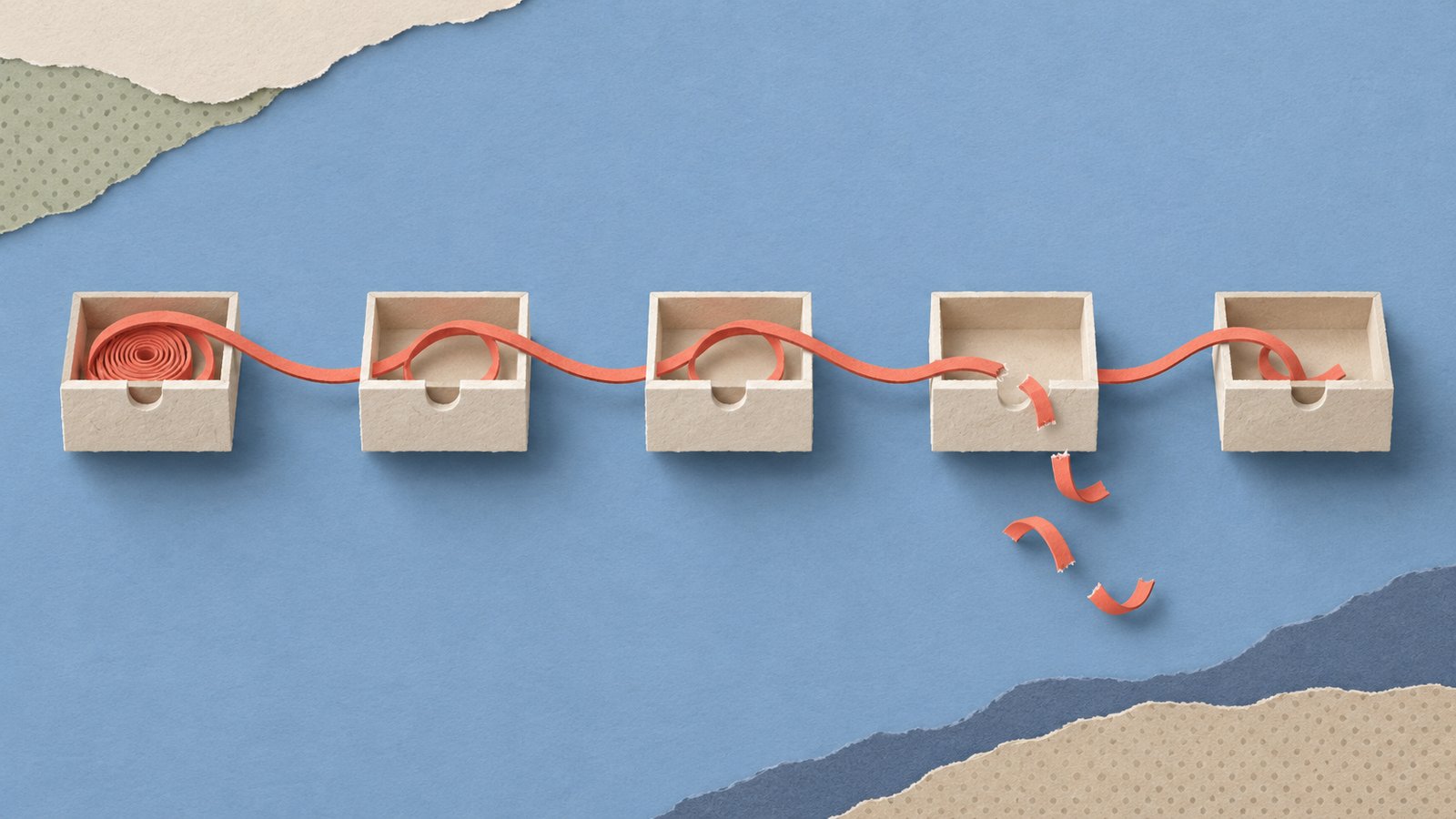
A message is half written to a stream. The code reaches an .await and waits for the writer to become ready. Meanwhile, another event arrives. The future holding the rest of the message falls through a trapdoor.
That is a possible outcome of tokio::select!. Tokio’s tutorial explains cancellation as dropping a future. Dropping it also drops the state held inside it. The work already done outside that future does not automatically reverse. A background task started by the operation may also keep running.
The useful review question is concrete: if this future disappears at an .await, what has happened already, and where is the information needed to continue?
A losing branch is dropped
tokio::select! waits on several branches. When one completes with a matching result, the remaining branch futures are dropped. In a loop, expressions inside select! create fresh futures on the next iteration. That matters when a losing future has made progress.
Consider this deliberately flawed send loop. A signal is handled by starting the loop again:
use tokio::io::{self, AsyncWrite, AsyncWriteExt};
use tokio::sync::mpsc;

async fn send<W: AsyncWrite + Unpin>(
    writer: &mut W,
    message: &[u8],
    signals: &mut mpsc::Receiver<()>,
) -> io::Result<()> {
    loop {
        tokio::select! {
            result = writer.write_all(message) => return result,
            Some(()) = signals.recv() => {}
        }
    }
}
Suppose write_all writes a prefix of message, then waits. A signal arrives and its branch wins. select! drops the unfinished write future. The next loop iteration calls write_all(message) again with the whole message.
Tokio documents this precise risk for write_all: a cancelled call may have written part of its buffer, while a later call starts at the beginning. The resulting output can contain a repeated prefix. The completed write_all call would have reported success or an error; the cancelled call provides neither result nor a byte count to this loop.
A partial read can lose a frame
The same shape appears on input. read_exact keeps reading until its buffer is full. Tokio says it is unsafe to cancel in a select! branch because it may already have read some data into the buffer.
Imagine reading a fixed-size frame from a stream. read_exact consumes part of that frame, then waits. Another branch wins. A fresh read_exact call reads from the stream’s new position. The cancelled call’s internal progress is gone. The buffer may contain bytes from that attempt, yet the new call has no saved count telling it where to resume. Simply retrying the whole frame read can combine the wrong bytes.
Tokio marks read and read_buf as cancellation safe when they lose a select! race: in that case, they have read no data. A loop that uses read can retain a buffer and an offset outside the replaceable future, then advance the offset after each completed read. The caller still has to handle partial reads and decide what to do if the larger operation is cancelled.
A safe receive can sit inside an unsafe operation
mpsc::Receiver::recv is cancellation safe. Tokio guarantees that if its call loses a select! race, it receives no message. This makes a loop selecting directly over recv() calls suitable for receiving from several channels.
Now put that receive inside a longer async function:
let job = rx.recv().await;
process(job).await;
Assume recv() has completed and process() is waiting. If the surrounding function’s future is dropped, the received job is part of the state being dropped. Calling the function again waits for the next job. The guarantee for recv() covered cancellation while that call was pending. It did not preserve a job after the call returned.
The same review applies to any sequence with a side effect before a later .await. Find the point where ownership moves or output changes. Then examine what dropping the surrounding future does at every later wait.
Progress can remain in the same future
Sometimes the branch should pause while another event is handled, then resume its existing work. Tokio’s tutorial shows how to do that: create the operation before the loop, pin it, and pass &mut operation to each select! call. The loop polls the same future again after another branch wins. It does not recreate the operation on every turn.
That pattern fits an event loop that must keep one operation in progress. It also needs a clear rule for when the operation is finally abandoned. Dropping the pinned future at that point still cancels it.
For an operation that must outlive the caller’s wait, a separate task is another design choice. Define how the task reports completion and how it receives a shutdown request. Tokio’s tutorial notes that a spawned task keeps running until it finishes or notices cancellation, for example through a Drop implementation such as the one on oneshot::Receiver, which tells its sender the receiver has closed.
Loss can mean delay
Lost bytes are easy to picture. Cancellation can affect scheduling too. Tokio’s Mutex::lock documentation says a cancelled lock request loses its place in the fairness queue. The protected data stays intact. Repeatedly replacing the waiting future can delay that caller’s turn.
This is why a method’s cancellation guarantee deserves a look even when it returns no data. Ask what the method may have acquired, consumed, changed, or queued before it waits.
Review every await as a drop point
Start with each select! branch, especially one recreated inside a loop. Trace it through every .await. At each wait, write down three things:
- Progress inside the future: buffers, offsets, received values, and intermediate results that dropping it would discard.
- Effects outside the future: bytes written, input consumed, work started elsewhere, and positions in a queue.
- The next attempt: whether it resumes the same future, rebuilds one from saved state, or starts from the beginning.
Then choose the intended behavior. If cancellation means abandoning the operation, define what partial work is acceptable. If it means retrying, keep enough progress to retry correctly. If it means briefly attending to another event, retain and poll the same future.
A useful test makes partial progress possible, lets another branch win, and then runs the next attempt. Check the resulting bytes, received items, or completion signal. The trapdoor is at the .await; the review succeeds when the state on both sides of it is accounted for.
The Campfire
No commentsNobody has pulled up a log by this one yet. Be the first to say what you make of it.
Held for the desk. It appears after a look.