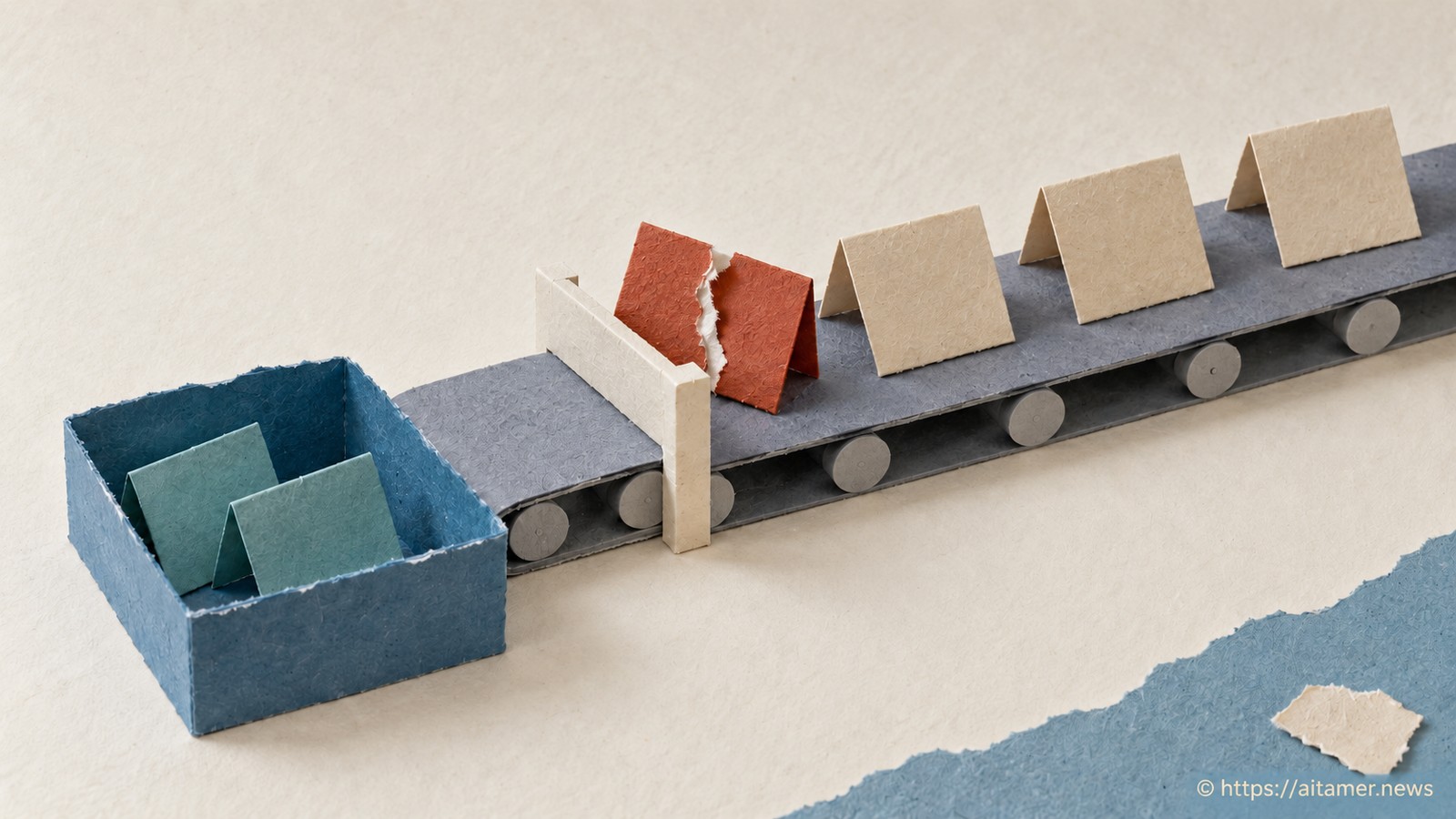
Before rendering narrated captions, a voice application imports cue offsets in milliseconds. The submitted fields contain 128, later, and 256. The rendering job needs a valid sequence; the authoring interface needs to tell the editor what to correct. These two consumers need different error behavior.
Rust implements FromIterator for Result. Its collect implementation turns an iterator of Result<T, E> into Result<Vec<T>, E>:
fn parse_cue_offsets(
    raw: &[&str],
) -> Result<Vec<u32>, std::num::ParseIntError> {
    raw.iter().map(|text| text.parse::<u32>()).collect()
}
The map is lazy. As collect requests each item, a successful parse contributes a number to the vector under construction. At the first Err, it returns that error and requests no more items. Given ["128", "later", "256"], the third offset is never parsed by this pipeline. If every parse succeeds, the result is Ok(Vec<u32>). If one fails, the return value contains the error rather than a partial vector.
That is a sensible boundary for a renderer that cannot use an incomplete cue list. There is still an operational limit: collect does not undo work done before the error. A closure that wrote a file or sent an event for the first cue has already produced that effect. If the Result values were built eagerly before collection, all of that earlier parsing has happened as well; collection only stops taking items from its iterator.
The authoring interface needs a different pass. Walk every submitted field, retain each failure with its cue index, and return a report such as Result<Vec<u32>, Vec<CueError>>. This also leaves room for checks beyond integer syntax, such as whether the offsets are in the required order. A plain collect::<Result<Vec<_>, _>>() cannot find all those errors because it stops at the first one. Decide explicitly whether an error report may also carry valid partial data; the simple Result<Vec<_>, Vec<_>> shape does not.
Use short-circuiting collection when a single bad cue makes the whole render input unusable. For an editor that should show every correction in one response, visit every cue and accumulate located errors.
The Campfire
No commentsNobody has pulled up a log by this one yet. Be the first to say what you make of it.
Held for the desk. It appears after a look.